Location
Can You Use a VA Loan to Buy Land and Build a Home?
December 30, 2025
-
Get Your Free Guide Book
Inspiration, process, and more to get you started on the right foot.
-
Find a Design Studio
Our team of experts is available to design and build your dream home typically within 75 miles of our Design Studios. Find a location near you.
A VA loan to buy land and build a home is not only possible, it can be one of the most affordable paths to a custom build when you follow the right steps. The key is using a construction-to-permanent structure that funds the lot and the build, then converts to a long-term mortgage after final inspection. With the right lender and builder, you can structure one closing, one appraisal sequence, and one set of closing costs.
Success comes down to eligibility, a well-documented budget, and a builder qualified to work under VA guidelines. This guide explains how the single-close process works, what lenders verify, which costs are typically financed, and how to compare alternatives if a different loan better fits your timeline or budget.
How to Use a VA Loan to Buy Land and Build a Home
The VA allows a construction-to-permanent pathway in which your lender finances the land purchase and new construction, then rolls the short-term note into a standard VA mortgage at completion. In practice, that means one set of disclosures, one closing, staged draws to your builder as work progresses, and conversion to permanent financing after the final inspection.
Some lenders avoided these loans in the past due to complexity. That changed when the agency clarified documentation and inspection checkpoints, giving lenders a predictable checklist and borrowers a clearer roadmap. For borrowers, that clarity reduces uncertainty about timing, appraisals, and cash due at closing.
If you need a deeper dive on structure and milestones, review VA construction-to-permanent financing details alongside your lender’s process so you understand how funds are released during the build. A helpful primer is to align your builder contract and plans with your lender’s draw schedule from the start.
Construction-To-Permanent VA Flow
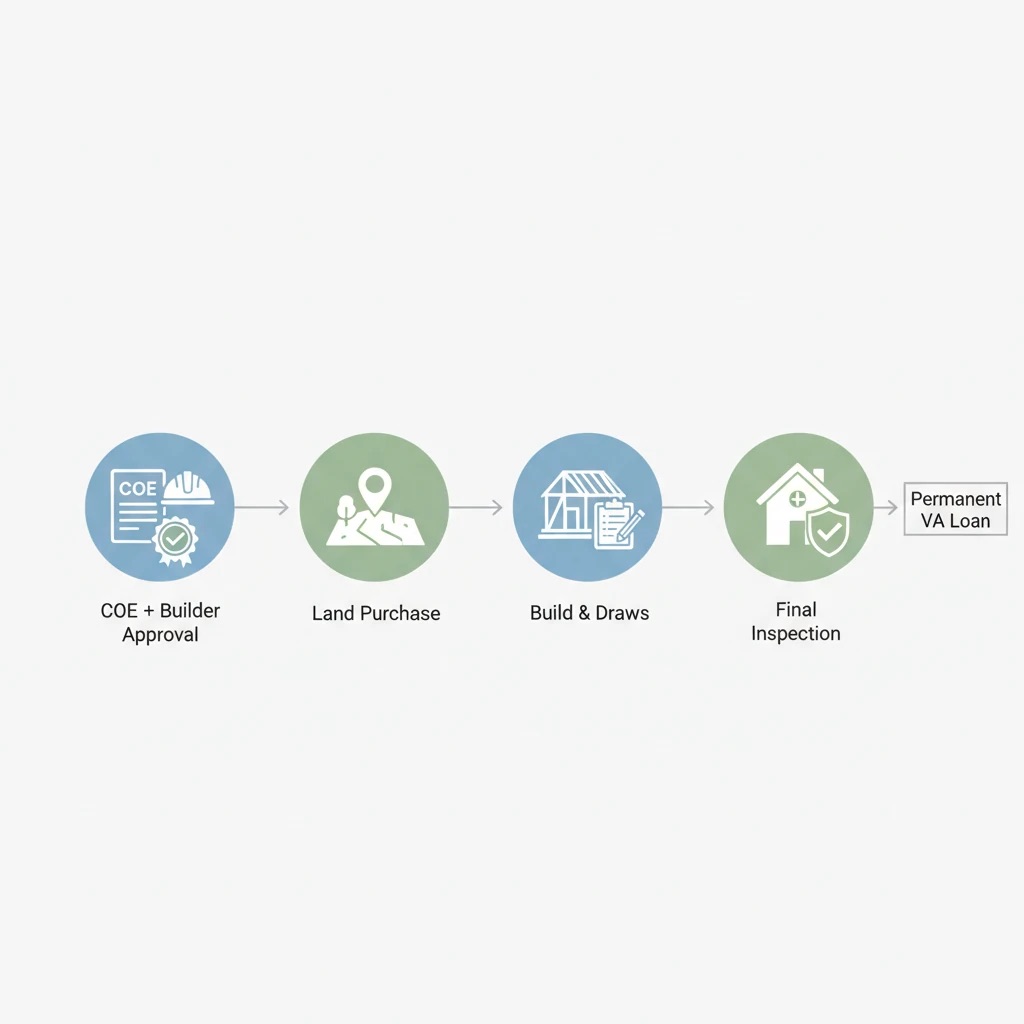
The updated pathway is designed to streamline both approvals and costs. According to VA News guidance, borrowers take four coordinated steps: obtain a Certificate of Eligibility, select a VA-registered builder, meet required appraisal checkpoints, and roll the construction note into a permanent VA loan at completion. Early adopters reported faster approvals and avoided duplicate closing expenses under this single-close model.
At a practical level, your lender tracks work through inspections tied to each draw. Funds are released when the inspector confirms the specified stage has been completed to code and in line with your plans and budget.
Step-By-Step Plan to Combine Land and Build
• Confirm eligibility by requesting your Certificate of Eligibility and discussing credit, debt-to-income, and reserves with your lender.
• Select a VA-registered builder and align on plans, specs, and a realistic line-item budget with contingencies.
• Identify the lot and verify utilities, access, zoning, and any site improvements required before foundation work.
• Apply for conditional approval with your complete package: plans, specs, itemized costs, and builder credentials.
• Order the initial appraisal and title work that reflect both land value and the completed-home value.
• Close the single-close construction loan and fund the lot purchase, then follow the agreed draw schedule.
• Complete inspections at each stage and manage change orders in writing to keep budget and scope aligned.
• At final inspection and completion, convert automatically to the permanent VA mortgage with no second closing.
For a process walk-through that complements these steps, many borrowers find it helpful to review a lender’s process for obtaining a construction loan and compare it to the builder’s construction timeline.
Eligibility Checkpoints Lenders Verify
Lenders look for a complete package that demonstrates you can repay the loan and the project can be built to code and budget. Expect a review of your credit profile, income, assets or reserves, and a debt-to-income calculation that includes the expected permanent payment.
The builder must meet program standards and be approved by the lender for VA construction. The property must meet VA minimum property requirements, and the appraisal must support the value of the completed home on that specific lot. Because approval hinges on documentation, start assembling your file early.
Checklist to Use a VA Loan to Buy Land and Build a Home
- Certificate of Eligibility confirming VA entitlement
- Two years of W-2s or tax returns and recent pay stubs or LES for income verification
- Credit report and explanations for any major credit events
- Asset statements showing reserves and funds to cover prepaid items or allowable costs
- Signed builder contract with plans, specs, and a fixed or guaranteed maximum price structure
- Detailed line-item budget including site work, utilities, and contingency
- Lot information: survey, utilities access, easements, flood zone, and zoning compliance
- Initial appraisal that reflects the as-completed value
- Draw schedule with inspection checkpoints and title updates
- Proof of builder’s licensing, insurance, and VA registration as required by the lender
The borrower pool for these loans is focused. Urban Institute research notes that Veterans represented 6.3 percent of the U.S. population in 2024, underscoring why specialized VA construction financing sits within a niche yet vital segment.
Builder and Property Standards
VA programs require a builder who is registered and in good standing with the lender and relevant agencies. The lot must be buildable, with legal access and utilities or documented plans to provide them. The design must meet local building codes and VA appraisal standards for safety, soundness, and sanitation.
Because lender overlays vary, confirm early whether your lender allows certain features like accessory structures, well and septic installations, or special foundation systems. Aligning expectations in writing prevents surprises when inspections occur or when the appraiser validates the scope of work.
Costs, Timeline, and Risk Controls for VA Construction
With construction-to-permanent VA financing, many lenders structure interest-only payments on funds disbursed during the build, then convert to a fixed payment at completion. Rate-lock features and buydown options can differ by lender and market, so ask how your lock will work over a multi-month build.
Funds typically cover the land purchase and many hard and soft construction costs, including site prep, permits, foundation, framing, systems, finishes, and inspections. Some lenders allow a contingency line item to address unknowns like rock excavation or utility extensions. Documenting these items up front helps underwriters verify feasibility.
Timeline Checkpoints and Draw Schedule
VA construction loans use staged draws to keep funds aligned with progress. Lenders verify milestones at the land purchase and key build stages, then complete a final inspection before conversion to permanent financing. The clarity of those checkpoints gives both borrower and builder a shared schedule for approvals and disbursements.
Independent analysis supports the efficiency gains. In its 2025 evaluation of government-backed construction lending, an Urban Institute report found that one-time-close VA borrowers finished builds about 2.3 months faster on average, saved approximately $7,400 in duplicate fees, and posted a 17 percent lower 24-month delinquency rate compared to two-step financing paths.
To align expectations on carrying costs during construction, it helps to estimate interest on draws and prepaids that accrue while the home is being built. For a borrower-friendly breakdown, review how lenders estimate how much you will pay for a construction loan, including interest during the build and remaining closing costs.
Mid-build changes are a common risk factor. Keep scope changes minimal, priced in writing, and documented in an updated budget before the next draw. That discipline protects your appraisal assumptions and avoids delays at final inspection.
Mid-content next step: If you want a conversation tailored to your lot, budget, and timeframe, explore VA construction-to-permanent financing options with a dedicated custom builder. You can also review broader construction loan options to see how VA compares with other pathways.
When a VA Construction Loan Is the Right Move, and When It Is Not
A VA construction loan shines when you are eligible, want to bundle the lot and build under one approval, and prefer to conserve cash for moving and furnishings. It can also help when appraised value supports your design choices and the builder’s fixed-price contract keeps risk in check.
It may not be the best fit if your builder or lender is not VA-approved, your design requires features outside a lender’s overlays, or you want to begin renovations on a property that is not considered new construction. In those cases, another loan program could be more efficient.
VA vs FHA and Conventional Options
For borrowers who do not meet VA eligibility, the HUD.gov FHA loans portal outlines a one-time-close construction program that generally requires a minimum 3.5 percent down payment, builder certification, and staged inspections that automatically convert to a 30-year fixed FHA mortgage at completion. That process mirrors the structure you would follow with a VA construction loan, just with different eligibility and down payment requirements.
On the conventional side, down payments tend to be meaningfully higher. The National Association of Realtors 2025 Profile reported a 19 percent median down payment across all home buyers, highlighting how zero-down VA construction financing can preserve cash for site costs or contingencies.
Government-backed loans play a smaller role in the mortgage market overall. 21.7 percent of 2024 home-purchase mortgages were government-backed. That smaller share helps explain why some lenders are less familiar with construction-to-permanent VA loans, making it crucial to work with teams that offer the program regularly.
If you are exploring options beyond VA, compare lender overlays, draw schedules, and lock policies side by side. A resource that helps frame these tradeoffs is a lender’s overview of construction loan options, which can clarify how program rules differ before you commit to plans and a budget.
Already own a lot and want to confirm build feasibility and financing in tandem. Start by reviewing builder guidance for those who already have land so your site details and financing strategy move forward together.
Build on Your Lot With Confidence: Next Steps for Veterans
With a clear plan, the right builder, and a lender experienced in single-close construction loans, a VA loan to buy land and build a home can deliver a streamlined path from lot search to move-in. The most successful projects start with complete documentation, a realistic fixed-price contract, and early coordination on appraisals and draw schedules.
Schumacher Homes focuses exclusively on building custom homes on our customers’ land, pairing one-stop-shop design studios and fully furnished model homes with construction financing available through Schumacher Mortgage. If you would like help aligning your lot, plans, and budget with a VA construction-to-permanent pathway, visit Schumacher Homes or start a conversation about VA construction loans on your lot.
Ready to evaluate your timeline and costs. Compare your goals with today’s VA construction-to-permanent options and take the next step toward a home designed for the way you live.
Have Questions? Let's Talk.
Frequently Asked Questions
How do I find and vet a VA-approved builder for new construction?
Start by asking lenders for their approved-builder list, then verify licensing, insurance, and VA registration. Review recent VA projects, request fixed-price bids with detailed scopes, and check lien histories and warranty policies before you sign.
Can I act as my own general contractor with a VA construction loan?
Typically no. Most lenders and VA program guidelines require a licensed, insured builder with demonstrated experience; owner-builder arrangements are rarely approved due to risk and oversight requirements.
If I already own land, can its equity count toward my VA construction financing?
Yes. Lenders can credit the appraised value of your lot (minus any liens) as equity, which can reduce cash needed for allowable costs and prepaids.
What if the appraisal for the completed home comes in below expected value?
You can revise plans to reduce costs, bring additional cash to cover the gap, or dispute the appraisal with new comps and documentation. Your lender can outline timelines and criteria for a reconsideration of value.
Can I use a VA construction loan to build a duplex or multi-unit home?
VA allows 1–4 unit properties if you occupy one unit as your primary residence. Lender overlays vary, so confirm up front whether they finance multi-unit builds and any additional reserve or rental-income rules.
Can VA Energy Efficient Mortgage (EEM) features be added to a new build?
Often yes. Qualified energy upgrades can be financed within program limits when documented up front; coordinate with your lender so improvements are included in plans, budget, and the appraised value.
What if I already have a VA loan? Can I still use my entitlement for construction?
Possibly. Second-tier entitlement may allow another VA loan if you have remaining entitlement and meet lender criteria; your COE and county loan limits will determine how much you can borrow without a down payment.